🔥 Register Your Interest For Our Primary/Secondary Science & Math Programmes

Register
Back to Home

Comparative Terms vs. Absolute Terms

Published By

Kenneth Mak

PSLE Science & Math Specialist | Secondary Science Specialist

Last Updated: December 11, 2025

Editorial Policy & Guidelines

Our content is meticulously crafted and reviewed by experts in the field of education, ensuring accuracy and relevance by referencing reliable sources aligned with the MOE syllabus in Singapore. Before publication and significant updates, we rigorously confirm the factual integrity, delivering well-informed articles grounded in scientific principles and teachings.

Table of contents

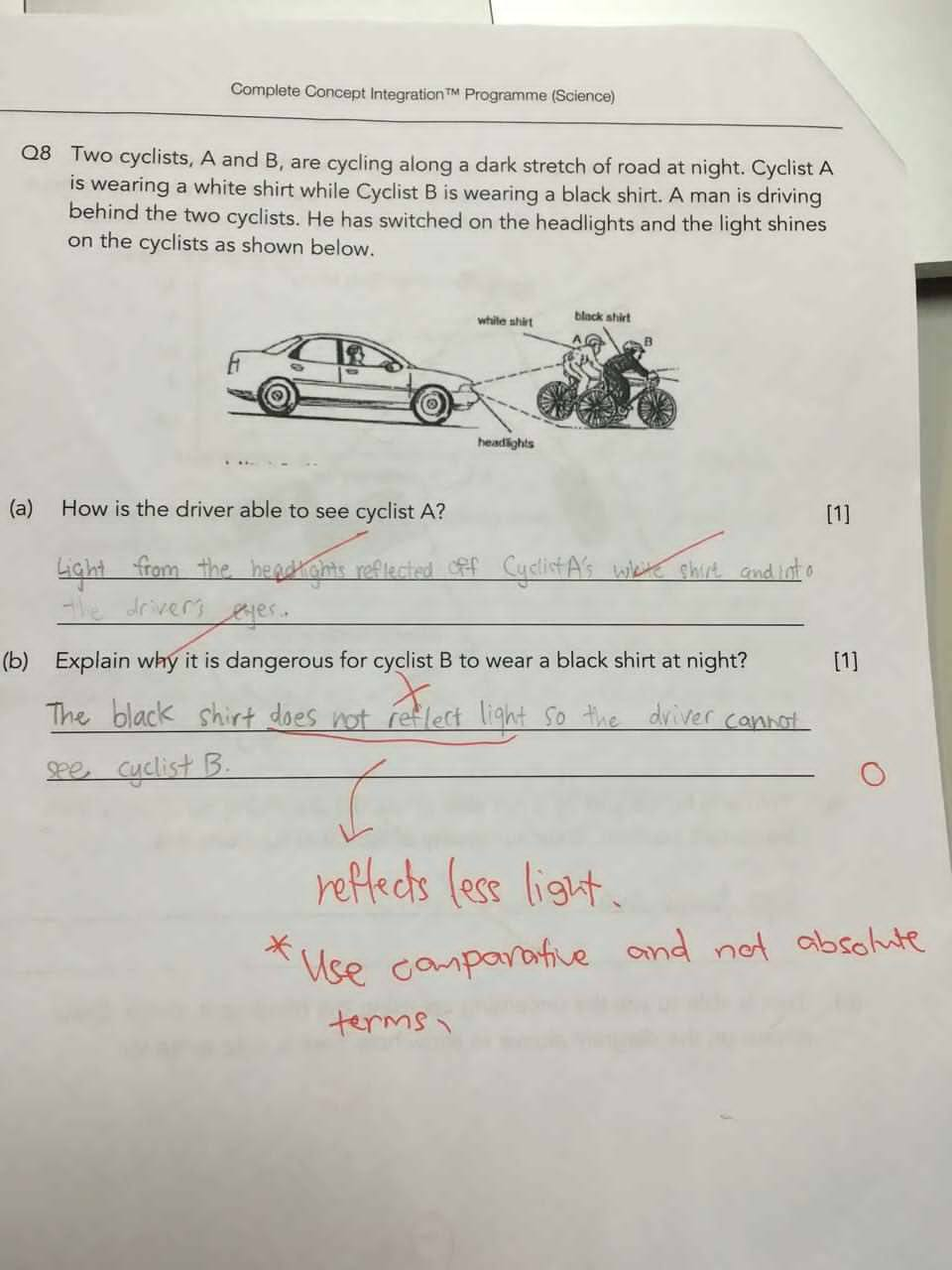
Just recently, while I was reviewing the past work collected from my students that have since graduated, I noticed that students tend to use COMPARATIVE  & ABSOLUTE terms interchangeably.

Read Also

  1. What Are Template Answers & Why Do They Matter?
  2. The CUE Method To Tackle Data-Based Questions

Question 1

Using the example above, it is not that the black shirt does not reflect light into the driver’s eyes but rather that the black shirt reflects less light (absorbs more light) into the driver’s eyes causing the driver to be able to see the cyclist less clearly.


Question 2

Question: What happens when we cover one side of the leaf with oil?

Student’s Answer: The plant will not be able to photosynthesise to make food and will eventually die.

Suggested Answer: The plant will be able to carry out LESS photosynthesis as the oil blocks SOME of the stomata from taking in carbon dioxide. Thus, the leaves are unable to take in enough carbon dioxide for photosynthesis, causing the plant to make LESS food.


Additional Notes

Some students were also asking when can they use the absolute terms.

We only use absolute terms when the answer is suggested by data.

For instance, if the light sensor reading is “0 lux”. Only then can we suggest that the object does not reflect any light.

Got Some Good Takeaways?

Check Out Our P4 Science Grade Accelerator Programme

Weekly class for P4 Science topics & exam revision

Learn More
About Kenneth Mak

Mr. Kenneth is the co-founder & PSLE Math Specialist of The Pique Lab. When it comes to primary Math, he is the go-to guy!

With more than 17 years of teaching experience, he has experimented with plenty of studying strategies & answering techniques to help them learn Math easier, better and faster. His deep understanding of what works and what doesn’t allows him to clarify doubts effectively and break down each complex problem sum into bite-sized, easy-to-grasp concepts.

He believes that a good teacher needs to be a good communicator. As such, he constantly seeks to work on his public speaking skillset in order to present the best version of himself to and for his students.

Seasoned by experience, he is known among parents for his engaging analogies that inspires fun in learning, building rapport with his students & helping them achieve tremendous academic results in the shortest period of time.

Leave the first comment

Table of contents

🔥 Similar Articles

February 13, 2026

2025 PSLE Science Examination Paper Analysis

Derrick Toh

PSLE Science Specialist | Secondary Science Specialist

November 12, 2025

Rate: How Many Men Can Build 5 Boats In 1 Day?

Trisha Wong

PSLE Math Specialist

November 12, 2025

Solving Whole Numbers Questions Using The Model Method

Trisha Wong

PSLE Math Specialist